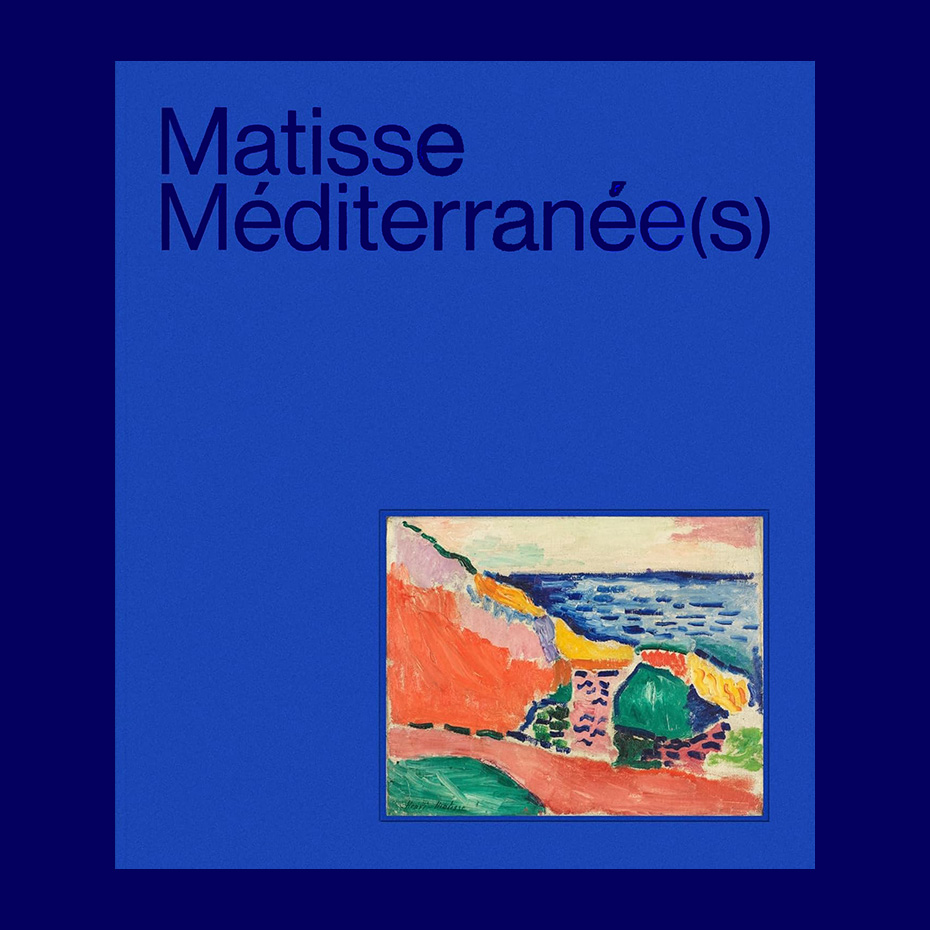
Matisse: Méditerranée(s)
Aymeric Jeudy (Ed.)
Musée Matisse & IN FINE, 2025
€39,00
“The Mediterranean is the most important. I, who was unfamiliar with it, and who am a man of the North, was the one that struck me the most.” Henri Matisse
The Mediterranean held a constant fascination for Matisse, from his first visit to Corsica in 1898 to his uninterrupted visit to Nice between 1917 and 1954, including numerous trips to Algeria, Spain, Italy, and, of course, Morocco.
By Matisse’s own admission, the Mediterranean basin, bathed in a light that amazed him, was crucial to his work, both in the experimentation with a new language that this environment allowed him to develop and in the pictorial tradition to which it was linked; even more so, in the mediation it offered him with the Orient and ancient cultures. Indeed, Matisse, who seeks to express his personal perception of the landscape, maintains a conceptual relationship with the sea and with the Mediterranean in particular: a sea made up of lived, sensitive, dreamed or fantasized spaces. This “machine for manufacturing civilization”, as Paul Valéry (first director of the Mediterranean University Center created in Nice in 1933) calls it, becomes, for the painter, the place of intense chromatic and plastic research, that of the discovery of new motifs. It is above all, beyond the obvious and the commonplaces, “a very old crossroads” of which Matisse was a witness and an actor, where – in the words of Fernand Braudel – “everything converged […]”. IN FRANS!
ISBN: 9782382032251